How to Repair a uPVC Window Sill
Scratches, chips, cracks and yellowing all turn up on a uPVC window sill sooner or later, and a white sill shows every mark clearly.
A south-facing sill that spends all day in direct sun discolours fastest, while one near a path or driveway usually takes the worst of the scratches and chips.
uPVC sills are popular precisely because they’re durable and low maintenance compared to timber.
But that doesn’t make them immune to everyday knocks or the weather conditions they sit in year-round.
But first: sill or cill?
You’ll see the part spelled two ways: window sill and window cill.
Both describe the same ledge that runs along the bottom of the frame, inside or out, and either spelling is correct.
An internal sill set into plaster gets far less weather exposure than one outside against brickwork, so the two rarely fail for the same reason.
This guide covers what you can fix yourself, what a repair kit will and won’t manage, and when the damage has gone past the point where filler and polish are enough.
Common problems with uPVC window sills – By double glazing repair experts
Surface scratches are the most common complaint, usually from a vacuum cleaner, a moved piece of furniture or careless DIY nearby.
Scuffs spread wider, often dragged across the plastic rather than knocked into it.
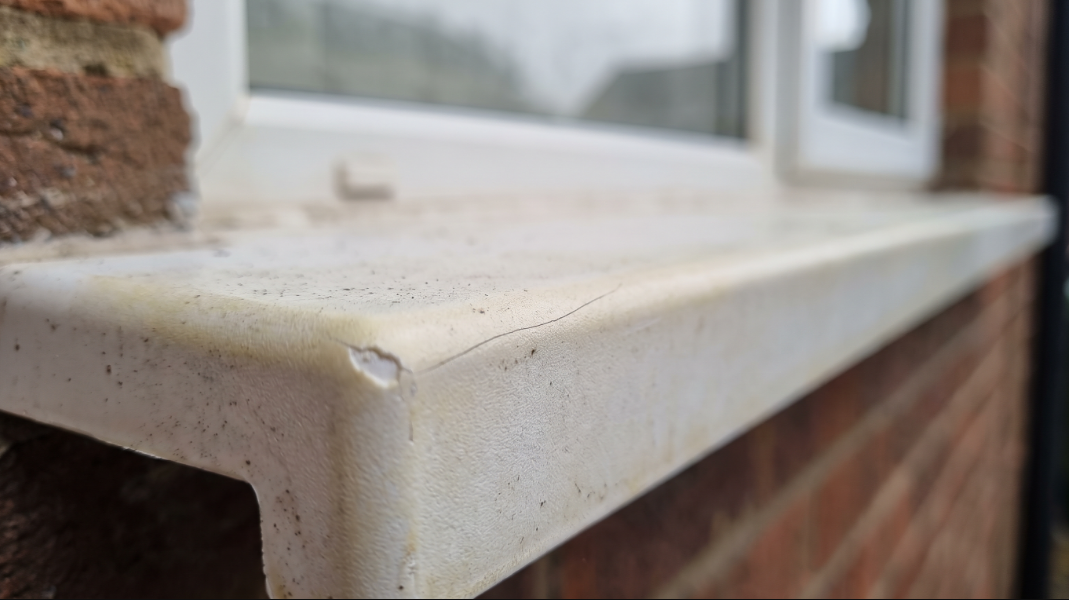
A scaffold pole, a dropped tool or a door catching the corner knocks a different kind of damage into the plastic: a proper chip with a rough edge, not a surface mark.
Cracks run deeper, often starting at a chip or stress point near the frame and spreading from there.
UV exposure causes discolouration in white uPVC over years, and grime leaves patches that can look similar.
Work out which one you’re dealing with before reaching for filler, since a stain needs cleaning, not repair.
Misted glass right above the sill is a separate problem again.
Window cills don’t fog up the way a sealed glass unit does, so the two issues rarely share a cause.
Fixing scratches, scuffs and stains yourself
Light surface marks respond well to a proper plastic cleaner and a soft cloth, worked in small circles rather than dragged in one direction.
For scuffs that don’t lift with cleaning alone, a mild abrasive compound made for plastic (not a household scourer) will usually take them back out.
Deeper scratches need a cut-and-polish approach: a fine abrasive first to level the mark, then a plastic polish to restore the shine.
Go gently, working in small passes rather than one hard scrub.
Push too hard with too coarse a compound and you’ll leave a duller patch where the scratch used to be.
Staining and yellowing are a different job entirely.
No amount of polishing restores UV-faded plastic to its original colour.
A dedicated uPVC restorer can bring some brightness back, though full restoration to the original colour is never guaranteed on an old, sun-bleached sill.
Repairing chips and cracks with filler
A two-part uPVC repair kit is the standard fix for a chip or a small crack.
Most trade suppliers stock one with a colour range wide enough to match white, cream and grey sills.
Clean and dry the area first, then apply the filler slightly proud of the surface so it sands back flush once cured.
Most DIY attempts fall down on colour matching, since the filler cures a shade lighter or darker than expected and the join stays visible after sanding.
A careful, patient repair disappears into aged, faded plastic, while a rushed one leaves a pale patch more obvious than the chip it covered.
Filler repairs stay cosmetic.
They restore the surface and stop the crack spreading, but they don’t add structural strength back to a sill that’s badly compromised.
They also won’t fix anything below the surface, so a crack running right through the material needs more than filler alone.
When a uPVC sill needs replacing, not repairing
Repair or replace: how to tell
A sill that’s structurally sound with cosmetic damage, small chips or one hairline crack is worth repairing.
A sill that’s cracked all the way through, pushed out of shape, or letting water in behind it needs replacing, and no amount of filler changes that.
At that point, a full replacement counts as an upgrade too.
A DIY repair kit is cost-effective for cosmetic damage.
But stretching one over a sill that’s badly discoloured or letting weather in just delays a proper fix.
Water damage behind the sill
Water getting in behind an old sill is the warning sign to take seriously.
It can rot the timber sub-frame the uPVC sits on, or work into the brickwork and mortar beneath the window.
By the time damage shows on the surface, the underside is often further gone than it looks.
Replacing at that stage protects the sill’s longevity far more than another round of filler.
Do you need to remove the window?
Replacing a sill doesn’t automatically mean removing the entire window.
On most installations, a specialist can inspect the fixings, loosen and remove the sill, then fit a new one around the existing window without disturbing the glass.
Whether the frame needs supporting during the swap depends on how the original was fitted.
A sagging or previously-repaired frame edge is the clearest sign it needs a trade visit rather than a fifteen-minute DIY job.
Sealing around the sill to stop draughts and water
Even a sill in good structural condition can let cold air and water through if the seal around its edges has failed.
The strip where the sill meets the window frame, and the mastic or silicone line where it meets the brickwork outside, are both common points of failure on external upvc sills exposed to years of weather.
A cracked or shrunk seal lets water track in behind the sill rather than running off it. It is often the real cause of the staining and softening people mistake for sill damage.
Small weep holes along the underside of an external sill drain that water back out.
Leaves and grit block them more often than expected, so check they’re clear before assuming the seal has failed.
Resealing around the frame, or fitting a fresh replacement gasket where the old one’s perished, is what keeps that water off the timber sub-frame and the brickwork beneath the window in the first place.
Frequently asked questions on window sill repairs
Can you paint a uPVC window sill?
Yes, with a specialist uPVC paint rather than standard masonry or gloss paint, which won’t bond properly to the plastic and will peel within months. It’s a reasonable option for covering old repairs or a mismatched colour, though it needs proper surface prep first for a durable finish.
Why do uPVC sills turn yellow or discolour over time?
UV exposure breaks down the outer layer of the plastic gradually, and south or west-facing sills discolour fastest since they take the most direct sun. Grime adds to it, which is why a clean can sometimes brighten a sill that looks worse than it really is.
Does replacing a sill mean removing the window?
Not usually. A specialist can typically loosen and remove the old sill without touching the window frame or glass, then fit the replacement around what’s already there. Full window removal is only needed if the frame itself is damaged.
Is a small chip in a uPVC sill something to worry about?
Not urgently, but it’s worth fixing before it spreads. A chip left alone gives water somewhere to sit and can develop into a crack over a wet winter, so a filler repair now is a lot less work than a replacement later.
What Totalseal Repairs can help with instead
Sill repair and replacement isn’t a service we offer, since it sits outside the double glazing repairs we specialise in across Central Scotland.
A repair kit or a specialist sill repair service is the right call instead.
Where we do come in is everything else around that window.
Whether it is misted or blown glass unit, a failed seal letting draughts or damp in, or hardware that’s stopped working.
A stiff multi-point lock, a dropped hinge, or a handle that’s stopped catching properly allhttps://totalsealrepairs.co.uk/are-upvc-window-handles-universal count as hardware faults, and we fix those regularly too.
If your windows need some attention and you aren’t sure whether it’s a problem we can help with, get in touch with our friendly team today!
Call us on 01324 468 337 for honest advice on what’s wrong with your windows, no hard sell, just a straight answer and a free, no-obligation quote if it’s something we can fix.