Why Older Sealed Units Fail
If your windows were installed 15 or 20 years ago and one of them has started to mist up between the panes, you’re looking at a failed sealed unit. It’s one of the most common double glazing problems we deal with here at Totalseal Repairs, and it happens to virtually every set of windows eventually.
But what actually goes wrong inside the glass? And why do some units last decades while others fail within ten years?
Understanding how sealed units break down helps you spot the early signs and avoid paying for a full window replacement when only the glass unit needs swapping out.
How a sealed unit works – By double glazing Edinburgh professionals
A sealed unit is the glass panel that sits inside your window frame. It’s made up of two panes of glass separated by a spacer bar that runs around the entire perimeter.
The gap between the panes is filled with dry air or, in newer units, an insulating gas like argon. Argon is denser than air, which means it slows heat transfer and makes the window more energy efficient.
The unit is sealed around the edges with two layers of sealant. The inner layer (the primary seal) is usually butyl, a sticky, rubbery compound that creates an airtight bond between the spacer bar and the glass.
The outer layer (the secondary seal) is typically polysulphide or polyurethane, and it holds the whole unit together structurally while adding another barrier against moisture.
Inside the spacer bar, there is also a desiccant, a granular material that absorbs any trace of moisture trapped inside the unit during manufacturing.
Between the gas fill, the dual seal, and the desiccant, a well-made sealed unit keeps moisture out and insulating gas in for years.
But nothing lasts forever, especially when on the frontline between your home and the outside.
What causes sealed units to fail over time
Sealed unit failure is almost always a gradual process. They weaken slowly over years until they can no longer keep moisture out.
Several things drive that process, and in most cases, it’s a combination rather than a single cause.
Solar pumping
This is one of the main reasons older sealed units fail, and not many people know its official name.
Whenever sunlight falls directly on your window, the glass heats up. Even on a cold day in Scotland, direct sun will still warm the glass.
As the glass warms, the air or gas trapped between the panes expands, pushing outward on the seals and creating pressure around the edges of the unit.
When the sun goes down or clouds roll in, the glass cools and the gas contracts, pulling the seals inward.
This cycle happens every single day. Over ten, fifteen, or twenty years, that constant push and pull gradually fatigues the seal material.
The glazing industry calls this solar pumping, and it’s the single biggest factor in sealed unit failure over time.
UV degradation
Ultraviolet light breaks down the sealant compounds around the edge of the unit. The butyl primary seal and the polysulphide secondary seal both lose flexibility and adhesion with prolonged UV exposure.
As they become more brittle, they’re less able to cope with the daily thermal cycling described above.
This is why south-facing windows tend to fail before north-facing ones. They get more direct sunlight, more UV, and bigger temperature swings between the sunny side and the shaded side of the glass.
Age and material fatigue
Even without heavy sun exposure, sealants degrade over time. The polymers in butyl and polysulphide gradually lose their elasticity as they age. A seal that was perfectly flexible when it was installed 20 years ago may now be stiff, cracked, or pulling away from the glass surface.
The quality of the original materials matters here. A sealed unit made with good sealants, a well-filled desiccant, and proper gas retention will last far longer than a unit that was manufactured to a lower standard.
Poor installation or frame drainage
How the sealed unit was installed in the first place makes a real difference to how long it lasts.
If the unit wasn’t seated properly in the frame, or if the glazing packers were positioned incorrectly, the unit can sit unevenly and put extra stress on certain parts of the seal.
Blocked drainage channels at the bottom of the frame are another common issue. uPVC window frames have small drainage slots that let water escape from the rebate.
If those slots are blocked by paint, dirt, or debris, water pools against the bottom edge of the sealed unit and attacks the seal from the outside.
We see this often in older properties where the frames haven’t been cleaned or maintained for years.
Cleaning chemicals
It is not only a lack of cleaning that causes problems.
Strong chemical cleaners and solvent-based products can damage the edge seals if they’re applied directly to the glass edges or the frame rebate.
Over years of repeated cleaning, the chemicals gradually eat into the sealant and weaken the bond. Pressure washers aimed at the window seals can force water past an ageing seal as well.
What happens once the seal fails in your double glazing unit
Once the perimeter seal starts to let air through, the process is slow but inevitable.
Damp outside air seeps into the gap between the panes. The desiccant inside the spacer bar absorbs the incoming moisture, which is exactly what it’s designed to do.
But the desiccant has a finite capacity. With fresh, damp air entering the unit every day, it eventually becomes saturated and can’t absorb any more.
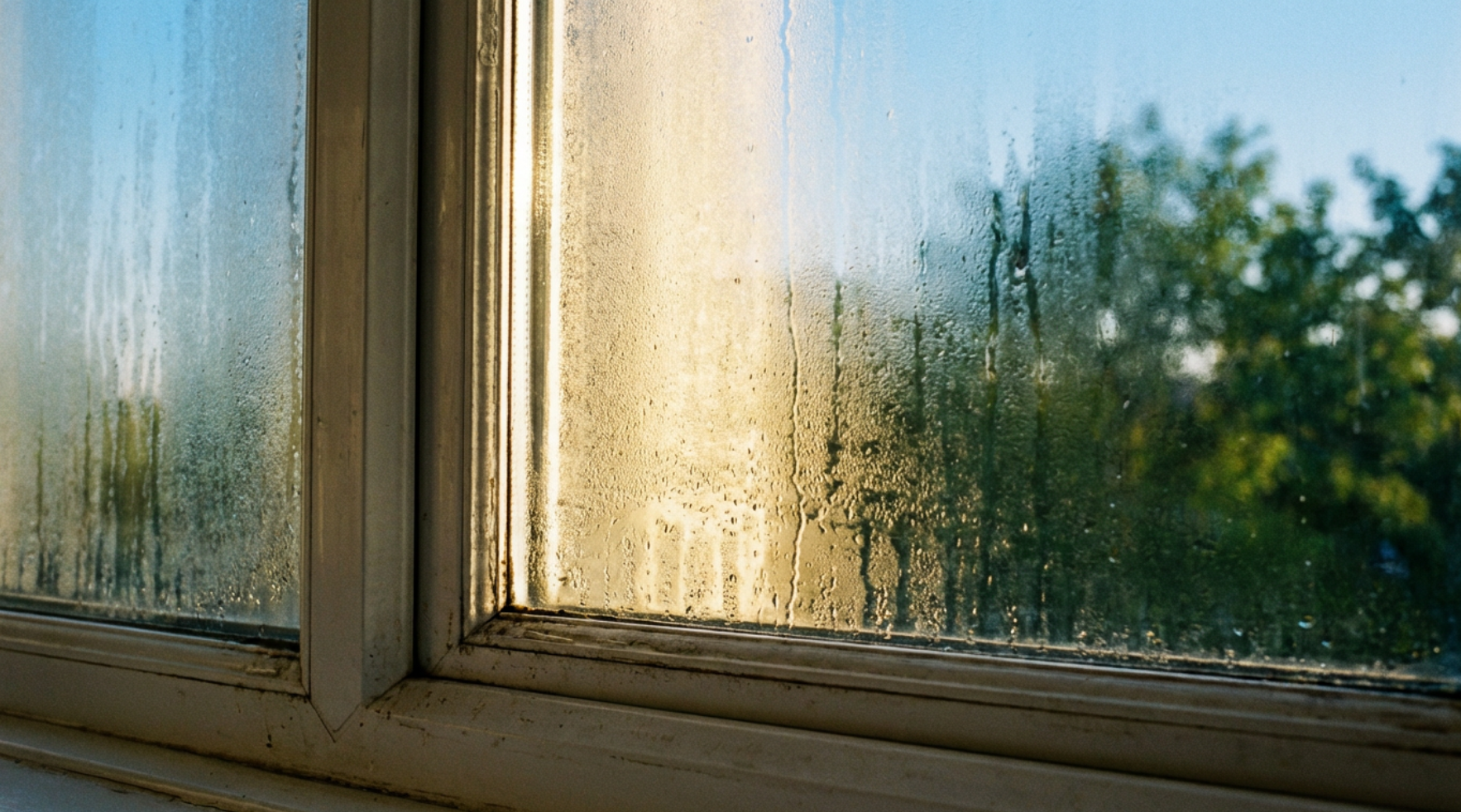
At that point, moisture starts condensing on the inner surfaces of the glass. You’ll see it as a faint misting or fogging, usually at the bottom of the window first, and it tends to be worse on cold mornings.
If it’s left long enough, something worse happens. The chemicals from the saturated desiccant mix with the condensation, and as the sun heats the glass during the day, those chemicals get baked onto the inner surface of the pane.
This leaves a cloudy, whitish deposit that won’t wipe off because it’s on the inside of the glass. At that stage, the staining is permanent and only goes away when the glass is replaced.
Any argon gas that was filling the unit will also have escaped by this point, which means the window’s thermal efficiency has dropped.
You might notice the window feels colder to the touch than the others in the house, or that the room feels draughtier near that window even when it’s closed. This means your heating is working overdrive to keep the room at a consistent temperature.
How location affects sealed unit lifespan
Not all windows in a house fail at the same time. Where the window sits on the building plays a big part.
It’s normal for one or two windows in a house to fail years before the rest. It doesn’t mean they were all poorly made. It usually means those particular windows had harsher conditions to deal with.
Here is how the location of your windows can affect how long your seal lasts.
South-facing and west-facing windows
South-facing and west-facing windows get the most sun exposure, and the temperature swings on a sunny day can be extreme. A south-facing pane might go from cold overnight to very warm in direct afternoon sunlight, then back to cold again after sunset. That rapid cycling accelerates seal fatigue.
Upper floor windows
Upper-floor windows are generally more exposed to wind and rain than ground-floor ones, which means more weather battering the seals from the outside.
Coastal properties
Properties in coastal or exposed locations deal with salt spray, stronger winds, and higher humidity, all of which put extra strain on the edge seals.
Central Scotland homes
In Central Scotland, cold, damp winters and frequent rain mean sealed units often work harder than they would in a drier, milder climate. This can affect the lifespan of your double glazed units.
How long do sealed units last
A standard double glazed sealed unit typically lasts somewhere between 15 and 25 years. Some will last 30 years or more if the materials were good and the installation was done properly. Others can fail in under 10 years if the manufacturing or installation quality was poor.
If your windows were installed in the 1990s or early 2000s, the sealed units are well within the age range where failure is common.
It doesn’t necessarily mean the windows were bad quality. It means they’ve done their job for two decades and the seals have reached the end of their working life.
Why replacement beats DIY repair
You might see adverts for companies that drill a small hole into the sealed unit, inject a drying agent or a cleaning solution, and then reseal the hole. The idea is to remove the moisture without replacing the glass.
In practice, this rarely works.
The original factory seal is already compromised, and drilling into the unit creates another weak point. The argon gas is long gone, so the thermal performance stays poor.
And if the desiccant chemicals have already baked onto the inner surfaces of the glass, no amount of drying agent will remove them.
Professional sealed unit replacement is a different approach entirely. Your old, compromised unit comes out and a brand new factory-sealed unit goes in.
Fresh glass, fresh desiccant, a proper edge seal, and (if you choose it) a new argon gas fill.
Don’t replace the window, replace the glass with Totalseal Repairs
A failed sealed unit doesn’t mean you need new windows. In the vast majority of cases, the frame is still perfectly sound. Replacing the entire window when only the glass has failed is unnecessary, expensive, and wasteful.
Totalseal Repairs replaces blown and misted sealed units across Central Scotland. And with over 30 years of trusted repair experience, we can give you an honest assessment and quote on the task at hand. What’s more? All our repairs are backed by a 5 year guarantee so you can feel confident you are getting the help you need for the job.
Call our team today on 07977 463 139 or 01324 468 337 for a free, no-obligation quote.